
How often should baghouse filter bags be replaced? There is no fixed replacement interval for every dust collector. Filter bag life depends on dust loading, operating hours, temperature, filter media, pressure drop, cleaning conditions, and the industrial process. Learn the key signs that indicate when filter bags need replacement.
How often should the filter bags in a baghouse dust collector be replaced? There is no universal answer. Industrial filter bag service life depends on operating hours, dust concentration, temperature, filter media, air-to-cloth ratio, pulse cleaning conditions, and the characteristics of the collected dust.
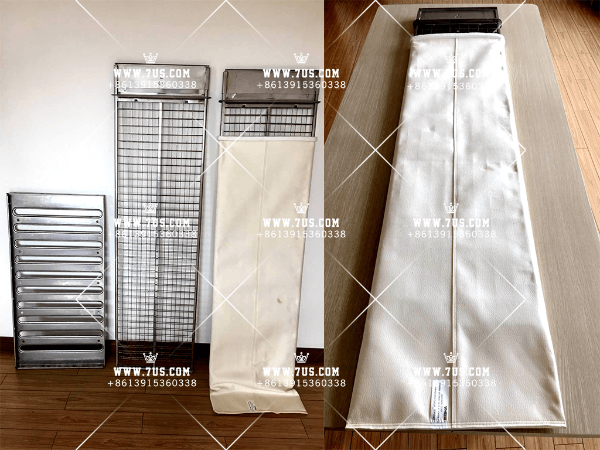
Is There a Standard Filter Bag Replacement Interval?
No. A fixed replacement interval cannot be applied to every industrial baghouse dust collector. Two dust collectors using similar filter bags may have very different filter life because their dust loading, operating temperature, production hours, cleaning frequency, and process conditions are different.
For this reason, filter bags should normally be evaluated according to their actual condition and dust collector performance rather than replaced simply because a fixed number of months or years has passed.
What Factors Determine Baghouse Filter Bag Life?
1. Operating Hours
A baghouse operating continuously for multiple shifts generally places more operating cycles on its filter bags than equipment used only several hours per day. However, operating hours alone cannot determine filter life because dust and process conditions also have a major influence.
2. Dust Concentration and Characteristics
High dust loading can increase the amount of particulate matter reaching the filter surface and may require more frequent pulse cleaning. Abrasive particles can also cause mechanical wear, while sticky or moist dust can increase pressure drop and make cleaning more difficult.
Dust chemistry should also be considered because unsuitable filter media can deteriorate when exposed to certain chemical conditions.
3. Operating Temperature
Filter media must be suitable for the continuous and peak temperatures of the application. Excessive temperature can cause filter material to shrink, harden, weaken, or otherwise deteriorate.
Higher-temperature applications may require specialized filter media such as aramid, PPS, or other materials selected according to the actual operating conditions.
4. Filter Media Selection
Correct filter media selection can significantly influence filter bag service life. Polyester, PTFE-treated media, antistatic materials, aramid, PPS, and other filter materials have different operating characteristics.
Filter media should be selected according to dust type, temperature, moisture, chemical conditions, filtration requirements, and applicable safety requirements.
5. Pulse-Jet Cleaning Conditions
Pulse-jet cleaning removes accumulated dust from the filter surface. Insufficient cleaning can result in excessive dust buildup and high pressure drop, while unnecessarily aggressive or frequent cleaning can increase mechanical stress on the filter bags.
Pulse pressure, cleaning frequency, compressed air quality, and control settings should therefore match the actual operating conditions.
How Do You Know When Filter Bags Need to Be Replaced?
Instead of relying only on time, maintenance personnel should look for changes in dust collector performance and the physical condition of the filter bags.
1. Abnormally High Differential Pressure
If differential pressure remains excessively high even after normal pulse cleaning and other system conditions have been checked, the filter bags may be heavily loaded, blinded, or approaching the end of their useful service life.
2. Visible Filter Bag Damage
Tears, holes, worn areas, damaged seams, deformation, or other physical defects can reduce filtration performance and may require filter replacement.
3. Increased Dust at the Outlet
An unexpected increase in downstream particulate matter can indicate damaged filters, sealing problems, installation issues, or other equipment faults. The cause should be investigated before simply replacing all filter bags.
4. Reduced Airflow or Unstable Operation
Excessive filter resistance can reduce system airflow. If cleaning and normal maintenance do not restore acceptable operating conditions, filter replacement may be required.
Should All Filter Bags Be Replaced at the Same Time?
The appropriate replacement strategy depends on the dust collector design and the condition of the filters. When many bags have reached a similar service condition, replacing a complete set can provide more consistent filtration resistance and simplify future maintenance.
If only isolated bags are damaged because of a specific local problem, the cause of that damage should be identified before deciding whether partial or complete replacement is appropriate.
How Can You Extend Baghouse Filter Bag Service Life?
Correct equipment selection and maintenance can help extend filter life. Use suitable filter media, control operating temperature, maintain the pulse-jet cleaning system, monitor differential pressure, prevent excessive moisture or abnormal process conditions, and inspect filter bags periodically.
Maintaining suitable filtration conditions can also help reduce unnecessary filter loading and mechanical stress.
Looking for Replacement Baghouse Filter Bags?
Jiangsu Erhuan Environmental Technology Co., Ltd. manufactures industrial dust collection equipment and filtration products under the 7US brand for international markets. Our product range includes baghouse dust collectors, industrial filter bags, cartridge dust collectors, filter cartridges, wet dust collectors, and related filtration components.
We provide OEM and private-label manufacturing services for overseas distributors, engineering companies, system integrators, and equipment manufacturers.
If you are sourcing replacement dust collector filter bags, provide the filter dimensions, filter material, operating temperature, dust characteristics, photographs or drawings, and required quantity for product evaluation.
Learn more about our industrial baghouse dust collection and filtration products.
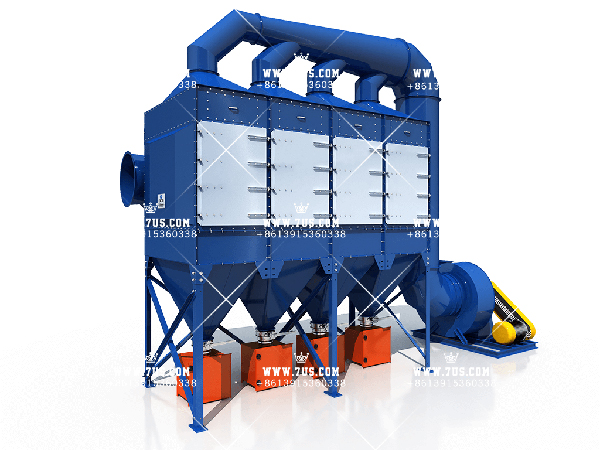
1. Vertical modular cartridge dust collector designed for high dust loading, fine dry dust and large-airflow industrial filtration applications. 2. Standardized DHC filtration modules can be combined to increase total airflow, allowing flexible system expansion according to project requirements. 3. Vertical cartridge arrangement with side-door access and eccentric cam fixing allows convenient filter inspection and replacement. 4. Single-stage cartridge filtration, two-stage cartridge + HEPA filtration, and three-stage cartridge + HEPA + activated carbon filtration configurations are available. 5. HEPA final filtration can be added for applications requiring very low particulate emissions, while activated carbon can be used as an additional polishing stage for suitable odor or VOC applications. 6. Standard single-module airflow ranges from 4,000 to 10,000 m³/h, and multiple DHC8 modules can be combined for systems up to 80,000 m³/h as shown on this page. 7. Equipment dimensions, filter media, color and OEM configuration can be customized according to project requirements.
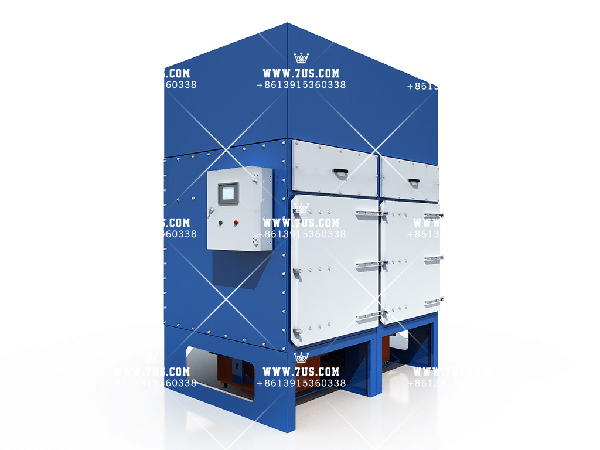
1. Vertical all-in-one cartridge dust collector designed for compact installation, convenient operation and efficient dry dust filtration. 2. Suitable for compatible dry dust and fume applications with dust-laden air temperatures below 120°C. 3. Vertical cartridge arrangement with side-door access allows convenient cartridge inspection and replacement. 4. Pleated cartridge filters provide a large filtration area within a compact equipment footprint, with automatic pulse-jet cleaning for routine filter cleaning. 5. Optional HEPA final filtration and activated carbon filtration can be added according to the required particulate and odor/VOC treatment needs. 6. DHC-YT series models are available with airflow capacities from 4,000 to 12,000 m³/h. 7. Equipment color, filter media, voltage, frequency and OEM configuration can be customized according to project requirements.
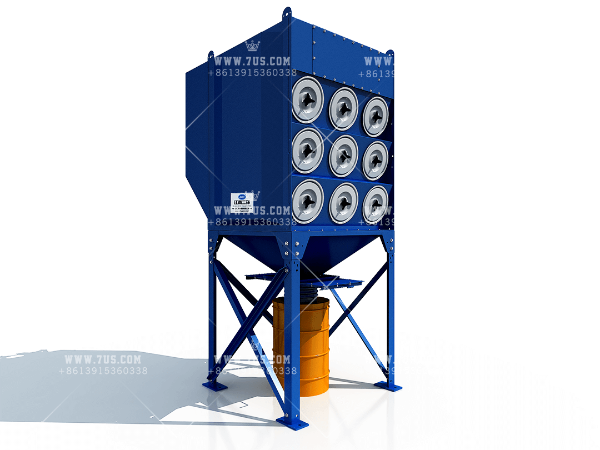
1. Downflow oblique modular cartridge dust collector designed for flexible capacity expansion through standardized modular units. 2. Compact modular construction helps reduce installation footprint and allows the equipment to be divided into transport-friendly sections for easier shipping and assembly. 3. Pleated cartridge filters provide a large filtration area within a compact equipment volume, with automatic pulse-jet cleaning for routine filter cleaning. 4. Standard EHDFT modules can be combined to increase total airflow according to project requirements, with configurations available up to 100,000 m³/h. 5. Optional two-stage filtration with cartridge filters and HEPA final filtration is available for applications requiring additional filtration performance. 6. Stainless steel construction, abrasion-resistant inlet arrangements, exhaust dampers and explosion protection components can be evaluated according to the application. 7. Suitable for compatible dry dust and fume applications without oil or water, subject to the confirmed dust characteristics and project safety requirements. 8. Equipment configuration, filter media, color a
No. 173, Wuwei Industrial Zone, Xushe Town, Yixing, Jiangsu, China© 1994-2026 7US.com. All rights reserved | Privacy PolicySite map
Phone