


How does a cyclone dust collector work, and when should you use one? Cyclone dust collectors use centrifugal force to separate coarse and heavy particles from an airflow without filter bags or cartridges. Learn about cyclone separator advantages, applications, and key selection factors for industrial dust collection.
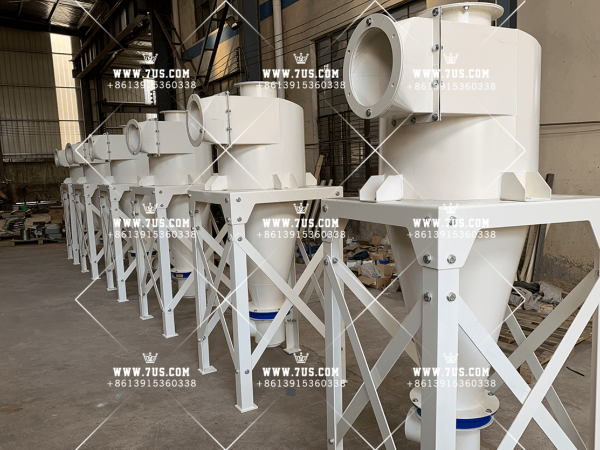
A cyclone dust collector, also known as a cyclone separator, uses centrifugal force to separate dust particles from an airflow. With a simple structure and no filter bags or filter cartridges, cyclone dust collectors are widely used for industrial dust separation and as pre-separators before secondary filtration equipment.
How Does a Cyclone Dust Collector Work?
Dust-laden air enters the cyclone separator and is directed into a rotating airflow. Centrifugal force moves heavier dust particles toward the outer wall of the cyclone, where they lose velocity and fall into the collection hopper below. The separated air then exits through the outlet at the top of the unit.
Because this separation process does not depend on conventional filter media, a cyclone dust collector can provide a relatively simple and robust solution for separating coarse particles from industrial airflow.
What Are the Advantages of a Cyclone Dust Collector?
1. Simple Structure and Reliable Operation
Cyclone separators have relatively few internal components and do not require filter bags or filter cartridges for the primary separation process. This simple structure can reduce routine filter maintenance and make the equipment suitable for continuous industrial operation.
2. Suitable for Coarse and Heavy Dust
Industrial cyclone dust collectors are particularly useful for separating larger and heavier particles. Typical applications can include woodworking dust, chips, mineral particles, process dust, and other materials where centrifugal separation is suitable.
3. Useful as a Pre-Separator
One of the most useful applications of a cyclone separator is pre-separation. A cyclone can be installed upstream of a baghouse or cartridge dust collector to remove a portion of the coarse dust before the airflow reaches the final filtration stage.
Reducing the incoming coarse dust load can help decrease the burden on downstream filter elements and may extend maintenance intervals in suitable applications.
4. No Filter Media in the Cyclone Separation Stage
Since centrifugal separation does not require fabric bags or pleated filter cartridges, there is no filter media to replace within the cyclone itself. This can make cyclone dust collection attractive for applications where simple mechanical separation is appropriate.
5. Suitable for Different Industrial Configurations
Cyclone dust collectors can be manufactured in different sizes and configurations according to airflow, dust characteristics, particle size, temperature, material requirements, and installation conditions.
Can a Cyclone Dust Collector Capture Fine Dust?
This is an important consideration when selecting a cyclone dust collector. Cyclone separators are generally more effective at separating larger and heavier particles than very fine dust. For applications requiring higher filtration efficiency for fine particulate matter, a cyclone can be combined with a cartridge dust collector or baghouse dust collector as part of a multi-stage dust collection system.
Cyclone Dust Collector vs Baghouse: Which Is Better?
The two technologies serve different purposes. A cyclone separator uses centrifugal force for mechanical particle separation, while a baghouse dust collector uses fabric filter bags to capture finer particulate matter.
For coarse and heavy dust, a cyclone may provide a simple first-stage separation solution. For finer dust or applications requiring higher filtration performance, baghouse or cartridge filtration may be more appropriate. In some applications, combining a cyclone pre-separator with a secondary dust collector can provide an effective solution.
How Do You Choose an Industrial Cyclone Dust Collector?
Before selecting a cyclone dust collector, important information includes required airflow, dust type, particle size and density, dust concentration, operating temperature, moisture or oil content, installation conditions, and downstream filtration requirements.
The correct cyclone configuration should be determined according to the actual application rather than equipment price or physical size alone.
Looking for a Cyclone Dust Collector Manufacturer?
Jiangsu Erhuan Environmental Technology Co., Ltd. manufactures industrial dust collection equipment under the 7US brand for international markets. Our product range includes cyclone dust collectors, cartridge dust collectors, baghouse dust collectors, wet dust collectors, industrial filter cartridges, and related filtration components.
We provide OEM and private-label manufacturing services for overseas distributors, engineering companies, system integrators, and equipment manufacturers.
If you are sourcing an industrial cyclone dust collector or cyclone pre-separator, provide the required airflow, dust characteristics, particle information, operating temperature, installation conditions, and other project requirements so that a suitable equipment configuration can be evaluated.
View our industrial cyclone dust collectors and separation equipment.
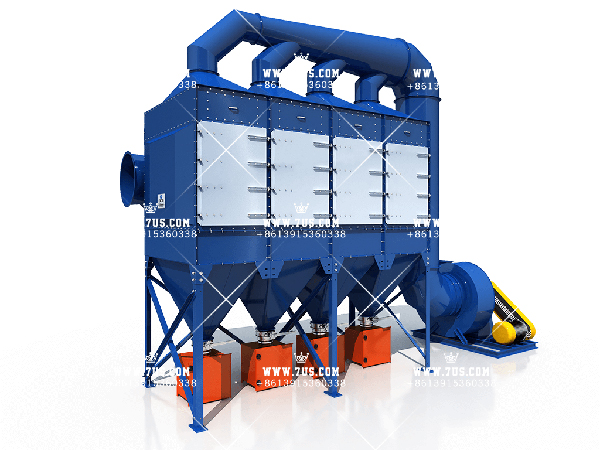
1. Vertical modular cartridge dust collector designed for high dust loading, fine dry dust and large-airflow industrial filtration applications. 2. Standardized DHC filtration modules can be combined to increase total airflow, allowing flexible system expansion according to project requirements. 3. Vertical cartridge arrangement with side-door access and eccentric cam fixing allows convenient filter inspection and replacement. 4. Single-stage cartridge filtration, two-stage cartridge + HEPA filtration, and three-stage cartridge + HEPA + activated carbon filtration configurations are available. 5. HEPA final filtration can be added for applications requiring very low particulate emissions, while activated carbon can be used as an additional polishing stage for suitable odor or VOC applications. 6. Standard single-module airflow ranges from 4,000 to 10,000 m³/h, and multiple DHC8 modules can be combined for systems up to 80,000 m³/h as shown on this page. 7. Equipment dimensions, filter media, color and OEM configuration can be customized according to project requirements.
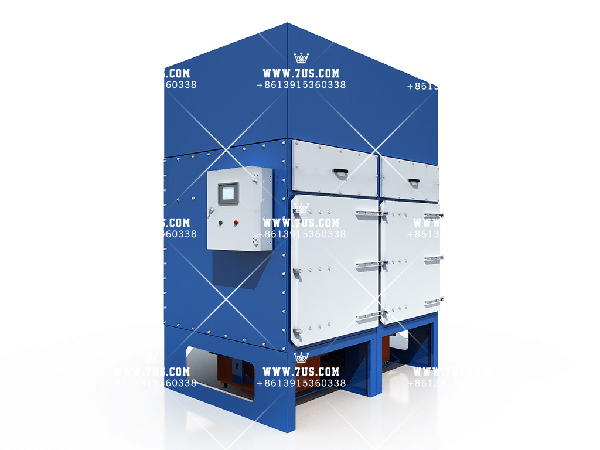
1. Vertical all-in-one cartridge dust collector designed for compact installation, convenient operation and efficient dry dust filtration. 2. Suitable for compatible dry dust and fume applications with dust-laden air temperatures below 120°C. 3. Vertical cartridge arrangement with side-door access allows convenient cartridge inspection and replacement. 4. Pleated cartridge filters provide a large filtration area within a compact equipment footprint, with automatic pulse-jet cleaning for routine filter cleaning. 5. Optional HEPA final filtration and activated carbon filtration can be added according to the required particulate and odor/VOC treatment needs. 6. DHC-YT series models are available with airflow capacities from 4,000 to 12,000 m³/h. 7. Equipment color, filter media, voltage, frequency and OEM configuration can be customized according to project requirements.
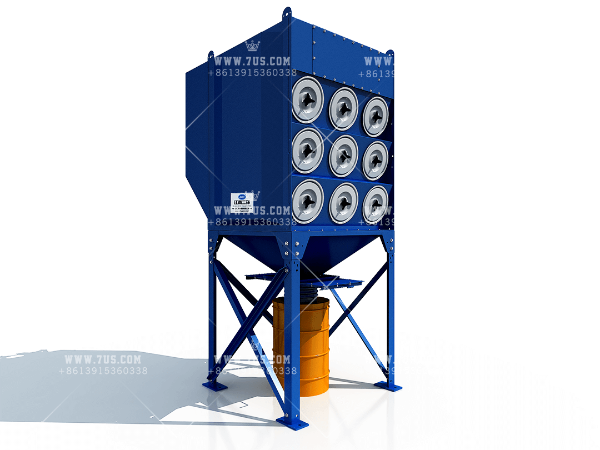
1. Downflow oblique modular cartridge dust collector designed for flexible capacity expansion through standardized modular units. 2. Compact modular construction helps reduce installation footprint and allows the equipment to be divided into transport-friendly sections for easier shipping and assembly. 3. Pleated cartridge filters provide a large filtration area within a compact equipment volume, with automatic pulse-jet cleaning for routine filter cleaning. 4. Standard EHDFT modules can be combined to increase total airflow according to project requirements, with configurations available up to 100,000 m³/h. 5. Optional two-stage filtration with cartridge filters and HEPA final filtration is available for applications requiring additional filtration performance. 6. Stainless steel construction, abrasion-resistant inlet arrangements, exhaust dampers and explosion protection components can be evaluated according to the application. 7. Suitable for compatible dry dust and fume applications without oil or water, subject to the confirmed dust characteristics and project safety requirements. 8. Equipment configuration, filter media, color a
Phone