
What information is needed to select an industrial dust collector? Required airflow, dust type, temperature, moisture or oil content, installation conditions, filter requirements, electrical specifications and safety requirements all affect equipment selection. This guide explains the key information buyers should prepare before requesting a dust collector quotation.
Selecting the correct industrial dust collector requires more than choosing equipment according to motor power or external dimensions. Dust characteristics, airflow, operating conditions, filtration requirements and installation environment can all influence the appropriate equipment configuration.
Providing complete application information at the beginning of a project can make equipment evaluation more efficient and reduce unnecessary changes during quotation and manufacturing.
1. Required Airflow
Airflow is one of the most important parameters used to determine dust collector size and filtration area.
The required airflow should be established according to the extraction requirements of the production process and the overall dust collection system.
The dust collector manufacturer can select suitable equipment after the required airflow is confirmed, but the complete system airflow should not be determined only from the dust collector itself.
2. Dust Type and Process
Different industrial processes generate different particulate matter. Grinding dust, welding fume, woodworking dust, metal powder, mineral dust and other materials can require different filtration equipment and filter media.
Useful information includes the production process, dust material, approximate particle characteristics and whether the dust is dry, sticky, abrasive or otherwise difficult to handle.
3. Operating Temperature
Gas temperature directly affects filter media and equipment selection.
Both normal operating temperature and possible peak temperature should be provided because filter materials have different temperature limits.
High-temperature applications may require specialized filter media or different equipment configurations.
4. Moisture and Oil Content
Conventional dry cartridge and baghouse dust collectors are generally designed for suitable dry particulate matter.
Significant moisture, oil mist or sticky particulate matter can cause filter blockage and high differential pressure.
For applications involving wet, oily or sticky dust, alternative filtration technologies or wet dust collection may need to be considered.
5. Dust Concentration and Loading
Dust concentration affects filtration area, cleaning frequency, hopper loading and dust discharge requirements.
Processes with heavy dust loading may require a different equipment configuration from applications containing relatively low concentrations of fine particulate matter.
Where a large amount of coarse material is present, suitable pre-separation such as a cyclone may also be considered.
6. Indoor or Outdoor Installation
The installation environment can influence equipment construction, surface treatment, electrical components and maintenance requirements.
Outdoor equipment may require additional consideration for weather protection, corrosion resistance and local environmental conditions.
Available installation space and maintenance access should also be confirmed before finalizing equipment dimensions.
7. Electrical Specifications
Voltage and frequency vary between countries and projects. Customers should confirm the required electrical supply before equipment production.
Common international requirements can include 380V 50Hz, 400V, 415V 50Hz, 440V 60Hz and other project-specific configurations.
Control voltage and electrical component requirements should also be confirmed when applicable.
8. Filter Media Requirements
Filter media should be selected according to dust characteristics, temperature, moisture, oil content and filtration requirements.
Industrial filtration options can include polyester, PTFE-treated media, antistatic media, flame-retardant media and other specialized materials depending on the application.
If a customer has a required filter specification or existing filter sample, drawings and dimensions can be provided for evaluation.
9. Safety and Explosion Requirements
Combustible dust applications require additional evaluation. Dust properties, process conditions, equipment location and applicable local safety requirements should be confirmed before equipment selection.
Requirements for explosion protection, fire protection, electrical classification or other safety measures depend on the complete system and local regulations.
These requirements should be defined by the customer's qualified engineering team or local system integrator according to the actual project.
10. Equipment Drawings and Site Information
Photographs, process layouts, available installation dimensions, duct connection information and equipment drawings can help clarify the required dust collector configuration.
For customized projects, drawings are particularly useful for confirming inlet and outlet positions, equipment dimensions and maintenance access.
Which Type of Dust Collector Should Be Selected?
Cartridge dust collectors are widely used for many fine and dry industrial dust applications and provide a large filtration area within a compact structure.
Baghouse dust collectors can be suitable for applications involving different dust loading, temperature or filter media requirements.
Wet dust collectors can be considered for certain applications involving combustible metal dust, moisture, oil or other conditions where conventional dry filtration may not be appropriate.
Cyclone separators are commonly used for pre-separation of larger and heavier particles.
No single dust collector technology is suitable for every industrial application.
What Should Be Included in a Dust Collector Inquiry?
To help us evaluate suitable equipment, please provide the following information whenever possible:
Required airflow, dust type, production process, operating temperature, moisture or oil conditions, indoor or outdoor installation, voltage and frequency, available drawings or photographs and any applicable safety requirements.
If the required airflow is not yet known, it should be confirmed by the customer's system designer or engineering company according to the extraction points, hoods and duct system.
Equipment Supply and System Engineering Responsibilities
The industrial dust collector is one component of a complete dust extraction system.
Jiangsu Erhuan focuses on manufacturing and supplying dust collection equipment, fans, filtration components, pulse-cleaning systems and related equipment according to the confirmed scope of supply.
Overall system engineering, capture hood design, duct sizing, airflow calculation and local regulatory compliance should be handled by the customer's qualified engineering company or system integrator.
Industrial Dust Collector Manufacturer for International Projects
Jiangsu Erhuan Environmental Technology Co., Ltd. was established in 1994 in Yixing, Jiangsu, China and specializes in industrial dust collection equipment and filtration products.
The 7US trademark is used for our international business.
Our product range includes cartridge dust collectors, baghouse dust collectors, wet dust collectors, cyclone separators, industrial filter cartridges, filter bags and related filtration components.
We provide OEM and private-label manufacturing services for overseas distributors, engineering companies, system integrators and equipment manufacturers.
Equipment dimensions, materials, colors, electrical specifications and filtration configurations can be evaluated according to customer requirements and manufacturing feasibility.
View our industrial dust collection equipment and filtration products.
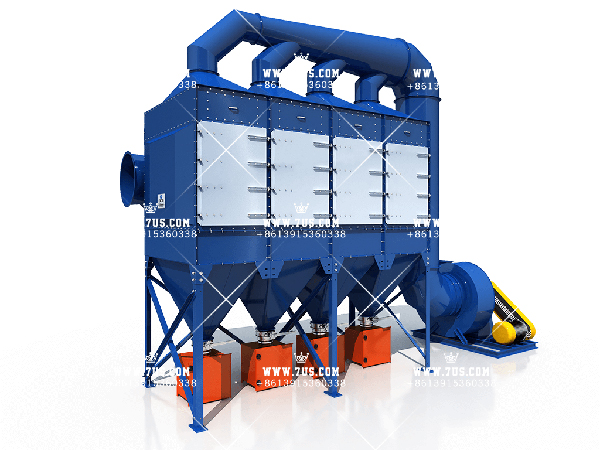
1. Vertical modular cartridge dust collector designed for high dust loading, fine dry dust and large-airflow industrial filtration applications. 2. Standardized DHC filtration modules can be combined to increase total airflow, allowing flexible system expansion according to project requirements. 3. Vertical cartridge arrangement with side-door access and eccentric cam fixing allows convenient filter inspection and replacement. 4. Single-stage cartridge filtration, two-stage cartridge + HEPA filtration, and three-stage cartridge + HEPA + activated carbon filtration configurations are available. 5. HEPA final filtration can be added for applications requiring very low particulate emissions, while activated carbon can be used as an additional polishing stage for suitable odor or VOC applications. 6. Standard single-module airflow ranges from 4,000 to 10,000 m³/h, and multiple DHC8 modules can be combined for systems up to 80,000 m³/h as shown on this page. 7. Equipment dimensions, filter media, color and OEM configuration can be customized according to project requirements.
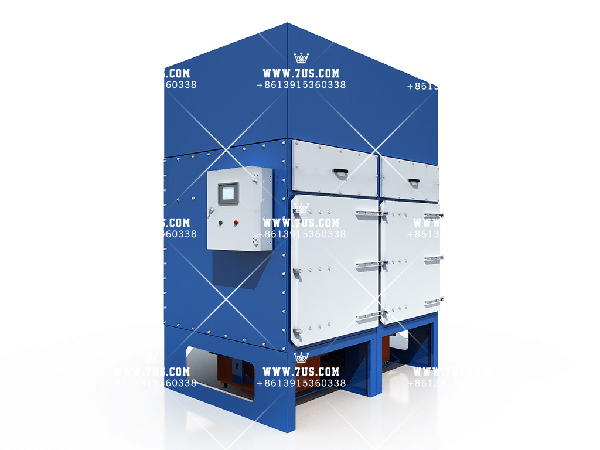
1. Vertical all-in-one cartridge dust collector designed for compact installation, convenient operation and efficient dry dust filtration. 2. Suitable for compatible dry dust and fume applications with dust-laden air temperatures below 120°C. 3. Vertical cartridge arrangement with side-door access allows convenient cartridge inspection and replacement. 4. Pleated cartridge filters provide a large filtration area within a compact equipment footprint, with automatic pulse-jet cleaning for routine filter cleaning. 5. Optional HEPA final filtration and activated carbon filtration can be added according to the required particulate and odor/VOC treatment needs. 6. DHC-YT series models are available with airflow capacities from 4,000 to 12,000 m³/h. 7. Equipment color, filter media, voltage, frequency and OEM configuration can be customized according to project requirements.
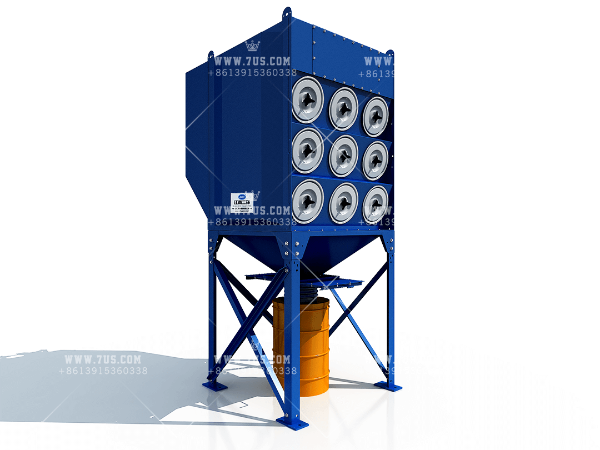
1. Downflow oblique modular cartridge dust collector designed for flexible capacity expansion through standardized modular units. 2. Compact modular construction helps reduce installation footprint and allows the equipment to be divided into transport-friendly sections for easier shipping and assembly. 3. Pleated cartridge filters provide a large filtration area within a compact equipment volume, with automatic pulse-jet cleaning for routine filter cleaning. 4. Standard EHDFT modules can be combined to increase total airflow according to project requirements, with configurations available up to 100,000 m³/h. 5. Optional two-stage filtration with cartridge filters and HEPA final filtration is available for applications requiring additional filtration performance. 6. Stainless steel construction, abrasion-resistant inlet arrangements, exhaust dampers and explosion protection components can be evaluated according to the application. 7. Suitable for compatible dry dust and fume applications without oil or water, subject to the confirmed dust characteristics and project safety requirements. 8. Equipment configuration, filter media, color a
No. 173, Wuwei Industrial Zone, Xushe Town, Yixing, Jiangsu, China© 1994-2026 7US.com. All rights reserved | Privacy PolicySite map
Phone