Modular Flat Baghouse vs. Round Baghouse: Shipping & Footprint
Both are pulse-jet bag collectors; the bag geometry decides how they ship and where they fit. This guide compares envelope-bag modules with round-bag houses on headroom, container loading, indoor discharge and maintenance.
The short answer
Both are pulse-jet bag collectors. The difference is geometry. A round bag is a long cylinder, so a round-bag house must be tall enough to hold the full bag length — and to pull the bags out again. An envelope (flat) bag is shallow, so a flat-bag module packs its filtration area into a lower, panel-built housing. That geometry decides two practical things overseas buyers care about: how the collector ships, and how much headroom it needs. 7US modular flat-bag units (EHFBC, 20–1,050 m² filtration area) are built as panels and sections, so they can travel as three housing sections — or, for experienced buyers, fully knocked down.
| Dimension | Flat-bag (envelope) module | Round-bag house |
|---|---|---|
| Footprint & height | Shallower front-to-back and lower for the same filtration area — the media lies flat | Taller vessel: the height follows the full bag length |
| Shipping & assembly | Bolts apart into upper, middle and lower sections (an 8-layer module ships as four height sections); full knock-down to panels for experienced buyers | Ships as fewer, bulkier welded vessel sections; container volume is used less efficiently |
| Filter change | Bags slide out horizontally from the clean side; no headroom above the unit is needed | Bags and cages pull out from the top; clear space above equal to the bag length is required |
| Indoor installation & HEPA | The top of the housing is free, so a HEPA stage stacks directly on top and cleaned air can recirculate indoors | The top is the bag-access side, so a HEPA stage cannot stack directly on top |
Geometry, footprint and headroom
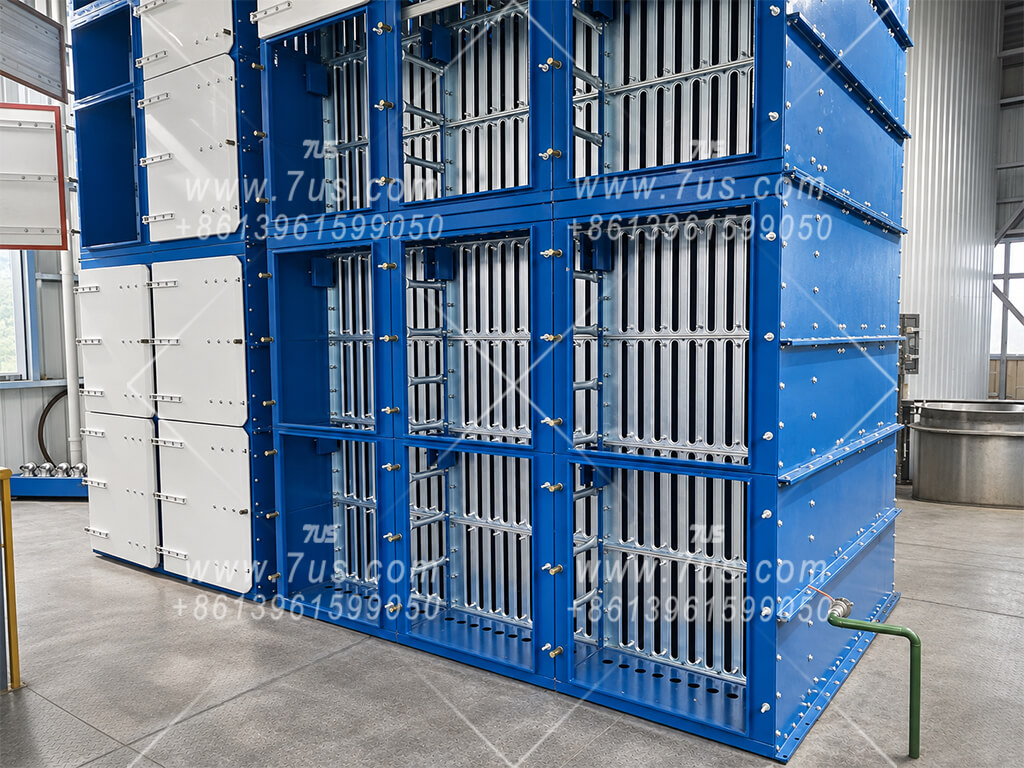
Filtration area per unit of floor space is similar in principle, but the flat-bag housing is shallower front-to-back and lower for the same area, because the media lies flat instead of hanging in long tubes. In practice this matters in three places: low factory ceilings, mezzanine or indoor installations where a tall round-bag vessel does not fit, and bag changes — envelope bags slide out horizontally, while round bags need clear vertical space above the collector equal to the bag length.
How a flat-bag collector ships
Standard export split. The machine is divided into three parts — upper housing, middle housing and lower housing — and loaded into the container section by section. Taller modules split further: the middle divides once more, so an 8-layer module — the tallest configuration — ships as four height sections. The fan and the electrical cabinet travel as separate items in the same shipment. On site, the sections are bolted back together in order; this is the route most buyers take. Our container loading guide gives the standard container dimensions behind these splits.
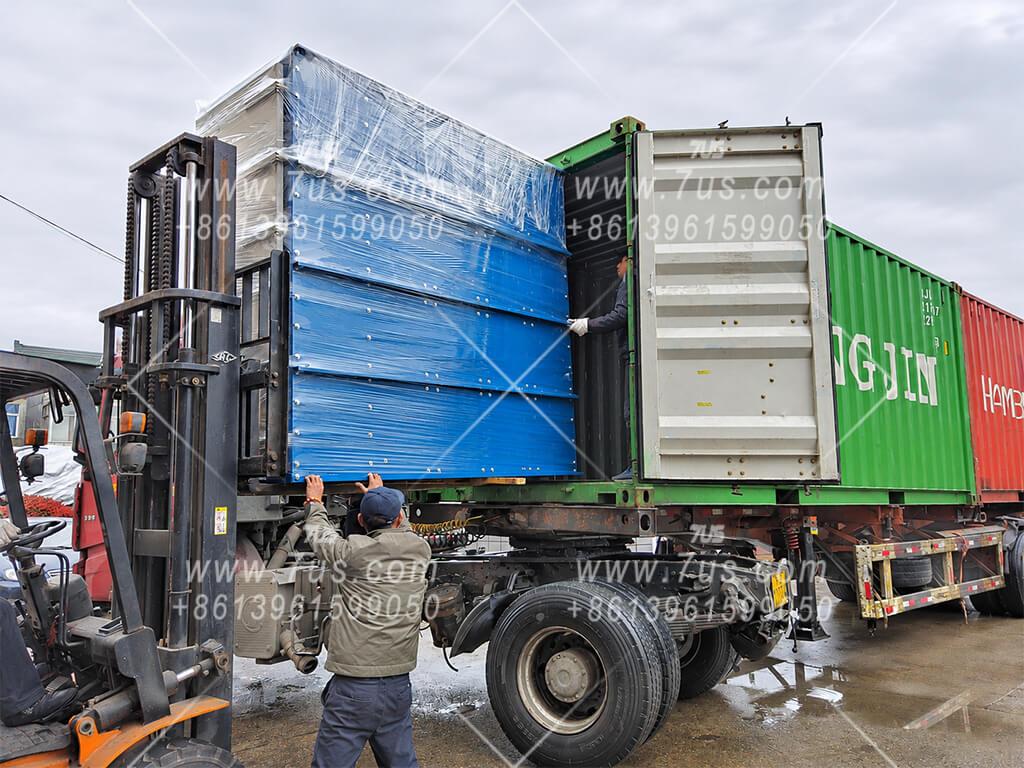
Full knock-down (experienced buyers only). Because the flat-bag design is panel-based, it can go further: broken down into individual panels and parts. One of our Australian customers, who had installed this model before and knew its structure well, asked for exactly that — the shipment that would normally take three containers went into one. On arrival, his crew reassembled the collector from the parts with adhesive and sealing strips, following the drawings, the way you build from a kit. We offer this only to buyers who have installed the model before or have a demonstrably experienced crew: the freight saving is real, but the assembly quality — and therefore the sealing — is in the buyer's hands.
Round-bag comparison. A round-bag house is usually welded as tall vessel sections sized by bag length. It ships in fewer, bigger pieces, which is simpler to receive — but the pieces are bulky, container volume is used poorly, and very tall units may need to be cut into more sections anyway.
Where flat bags are the specified choice
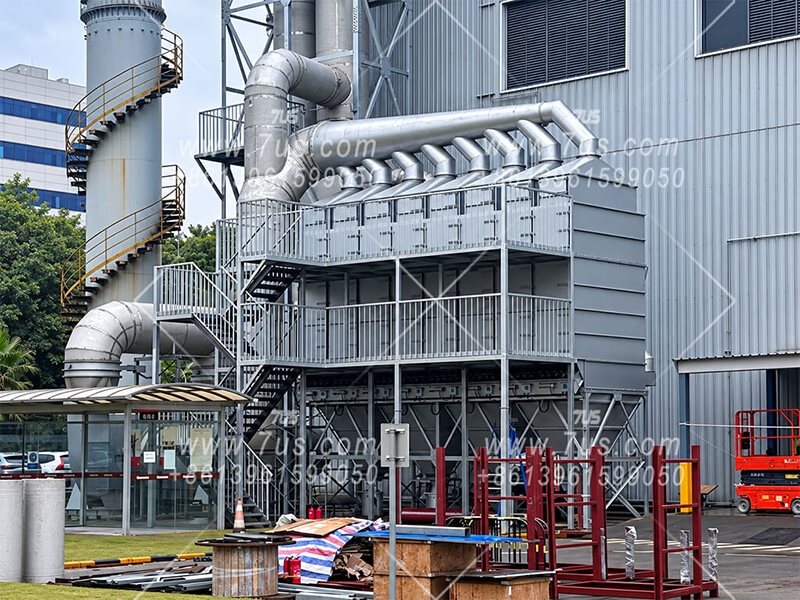
Flat-bag collectors are a niche — round bags remain the most widely used design — but in some applications the flat bag is specified outright. Most tobacco factories worldwide specify envelope-bag collectors. Flat bags are also chosen for indoor installation: in very cold or very hot climates, a large bag collector can be installed inside the hall and fitted with a HEPA stage, discharging cleaned air directly indoors with no heat loss through an exhaust stack. Constant-temperature workshops are the strictest case — the air is conditioned, so the collector has to stand indoors and the cleaned air has to recirculate; exhausting it would throw the heating or cooling away with it. The structure allows it because the envelope bags insert from the side, leaving the top of the housing free for a directly stacked HEPA stage. A round-bag unit cannot do this the same way: its bags and cages are loaded and pulled from the top, so the top cannot carry a HEPA stage.
Maintenance differences
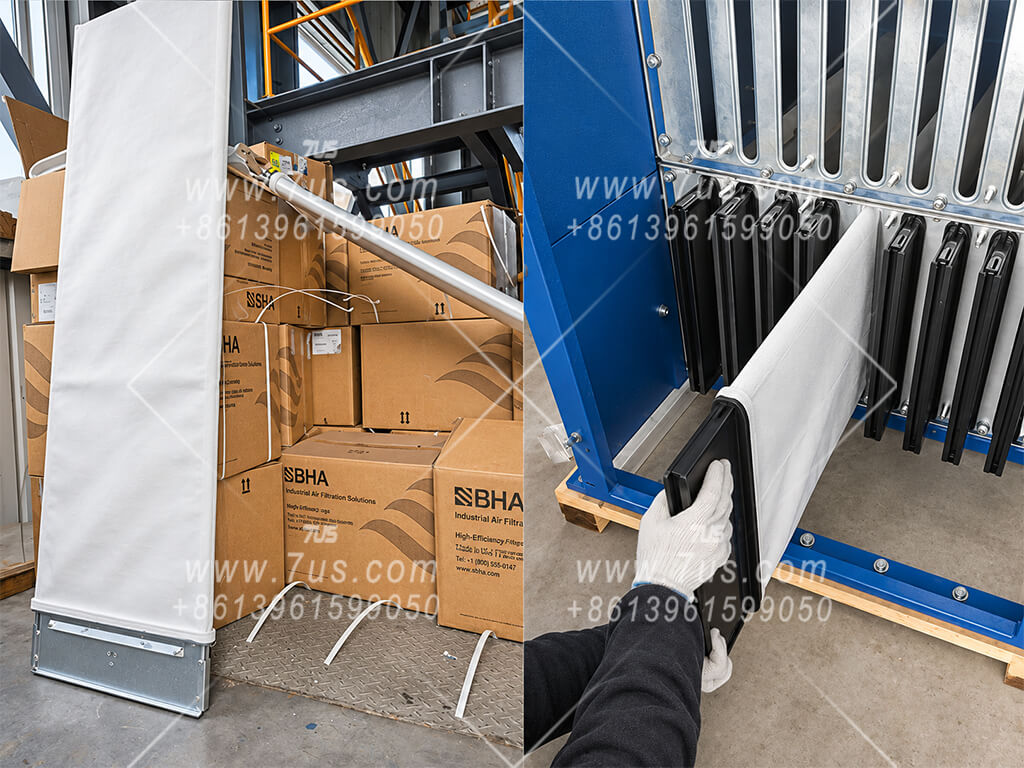
Envelope bags are changed from the clean side by sliding them out; no worker enters the dirty side and no overhead crane space is needed. Round bags are pulled upward out of the tubesheet, which needs the headroom noted above and, on large units, a lifting arrangement. Filter media cost per m² is comparable; the difference is access and downtime, not media price.
When a round baghouse still makes sense
Round bags are the long-established default in many plants: local crews know them, spare bags are stocked everywhere, and for very large single-vessel installations the design is proven at almost any scale. If headroom is generous, freight is short-haul, and your maintenance team is set up for round bags, there is no reason to switch. The flat-bag advantage appears when freight is ocean-going, headroom is tight, or the collector must be assembled indoors from parts.
Selection check
Headroom at the installation point (including bag-pull space) · ocean freight share of total cost · your crew's assembly experience (three-section split, or knock-down?) · filtration area and media required · who assembles and seals the unit on site. Send us these five points and we will quote the shipping split that fits.
Frequently asked questions
Can any buyer order the fully knocked-down version?
No. We offer it only to buyers who have installed this model before or can show an experienced assembly crew. Everyone else receives the standard three-section split, which is straightforward to bolt together.
Can a flat-bag collector discharge air indoors?
Yes. The envelope bags insert from the side, so a HEPA stage can be stacked directly on top of the housing, and the cleaned air can be discharged straight back into the hall — the arrangement used in very cold or hot climates and in constant-temperature workshops, to avoid losing heating or cooling energy. On a round-bag unit the bags and cages are serviced from the top, which blocks this layout.
How many containers does a flat-bag system need?
It depends on size and split. As a reference: one customer's system filled three containers in standard split form and one container fully knocked down. We calculate the loading plan per order, before the contract.
Does knock-down assembly affect sealing or performance?
The panel design is made for site assembly with adhesive and sealing strips per the drawings. Performance then depends on assembly quality, which is why this option is limited to experienced buyers.
Send us your process data
Dust type, airflow and site conditions — we will size the unit and reply with a scoped quotation.