Laser Cutting Dust Extraction: Sizing a Downflow Cartridge Collector
Professional buyers do not size a laser cutting collector by airflow alone. This guide explains the sizing basis that actually decides filter life and capture performance — negative-pressure rating, filtration area and media type — with a worked EHI example, plus how downflow pulse cleaning and spark management fit in.
1. What laser cutting dust and fume actually is
Laser cutting uses a focused beam to melt, burn, or vaporise metal. The process produces a mixture of fine metallic particles and fume, together with larger dross and spatter. The fraction that matters most for extraction is not what falls on the table — it is the fine, dry aerosol that remains suspended in the cutting zone and follows the extraction airflow.
That fine fraction is difficult for a filter for several reasons. Particle size is very small, so particles follow the airstream and penetrate deep into filter media rather than settling out by gravity. Dust loading can be high and intermittent, depending on cutting speed, material thickness, and the assist gas used. The dust is dry, abrasive, and electrically conductive — it does not form a soft, easily released cake like some wood or food dusts. And hot particles and sparks are present in the airstream: even a small number of glowing particles reaching a dry filter can create a fire risk.
A collector designed for laser cutting must therefore be evaluated not only on its ability to trap dust, but on how it handles fine particles over long operating periods, how it cleans, and how it protects the filter media from ignition sources.
2. Capture at the cutting table: downdraft zones
Extraction begins at the table, not at the collector. A laser cutting table is usually divided into downdraft zones, each with its own damper. Only the zone under the cutting head is opened during cutting. This is not a detail — it is the principle that makes extraction practical: closing unused zones concentrates airflow where cutting is actually happening, while a table that extracts from the whole bed at once spreads the same airflow too thinly.
Duct losses: the pressure available at the cutting table is what remains after ductwork losses. Long ducts, sharp bends, and undersized sections all reduce the pressure delivered to the table. Sealing: leaks in duct joints and zone dampers reduce the effective airflow at the cut. Extraction performance is set by the system, not by the collector alone.
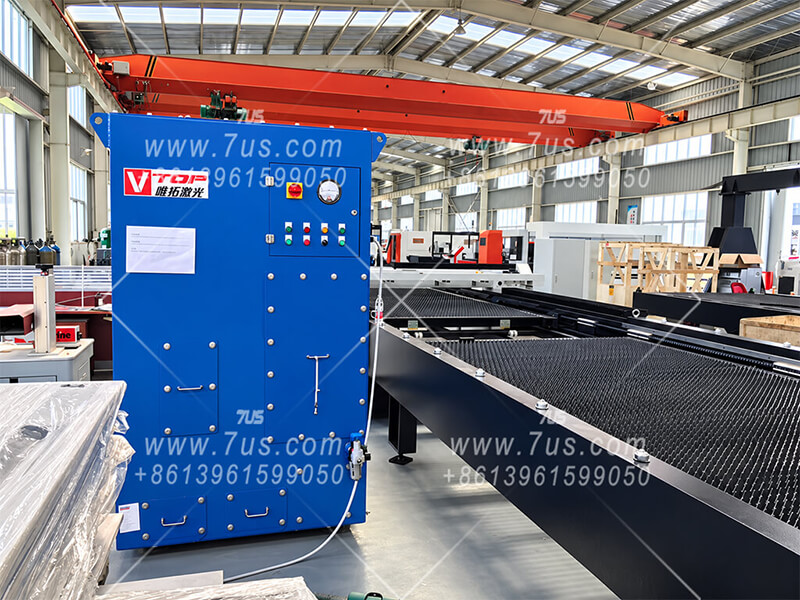
Responsibility: sizing the extraction to the cutting table — the number of zones, the duct layout, and the required airflow at the table — is the machine builder's design responsibility. 7US supplies the collector to the specified negative pressure, filtration area, and media type. A collector cannot correct a table design that does not capture fume at source, and a correctly designed table cannot compensate for a collector that is undersized for the required duty. See also our laser cutting dust collection application page.
3. Sizing the collector the professional way
Professional buyers do not size a collector by airflow alone. Airflow is a derived number, not a primary specification:
Airflow = Filtration Area × Filtration Velocity
Airflow, expressed in cubic metres per hour, is the result of two independent choices: how much filter area is installed, and how fast air is allowed to pass through that area. Quoting an airflow without stating the area and the media behind it is meaningless, because the same airflow can be achieved with a large filter operated gently or a small filter operated aggressively — with very different consequences for filter life, pressure drop, and cleaning frequency.
Three parameters form the professional sizing basis. Negative-pressure rating: the suction, usually expressed in pascals (Pa), that the collector must provide at its inlet to overcome the pressure losses of the table, the ductwork, and the filter itself as it loads with dust — the collector must deliver its rated airflow at that negative pressure, not at zero resistance. Filtration area: the sum of the area of all cartridges installed; more area means lower velocity through each square metre of media for the same airflow, and therefore lower resistance, gentler cleaning, and longer cartridge life. Media type: the media determines the allowable filtration velocity, how the dust cake forms and releases, and how the filter handles fine metallic particles.
| Media | Maximum filtration velocity | Note |
|---|---|---|
| Paper-fibre cartridges | ≤ 0.8 m/min | Roughly twice the filtration area of polyester in the same cartridge volume |
| Polyester cartridges | ≤ 1.2 m/min | Lower area per cartridge; higher allowable velocity |
Worked example — a 4-cartridge EHI unit. The 7US EHI series of integrated downflow cartridge dust collectors uses Ø352 × 660 mm cartridges (commonly called 350 × 660), with paper-fibre media and 21 m² of filtration area per cartridge. Models are available with 1, 2, 3, 4, or 6 cartridges, giving total filtration areas of 21, 42, 63, 84, and 126 m² respectively. For the 4-cartridge unit: 4 × 21 m² = 84 m², at ≤ 0.8 m/min gives 84 × 0.8 = 67.2 m³/min = 4,032 m³/h maximum. That figure is valid only because it is tied to the 84 m² area and the paper-fibre media — and it must still be checked against the negative-pressure requirement of the specific installation. When requesting a quotation, state the required negative pressure, the required airflow, and the preferred media type — then check that the offered filtration area gives a filtration velocity within the limits above.
4. Downflow collectors: how pulse cleaning works
The EHI series is an integrated downflow cartridge dust collector: dust-laden air enters from the top and flows downward through the cartridges toward the hopper. As air passes through the pleated cartridge media, dust is captured on the outer surface. Over time the dust layer thickens and the pressure drop rises; the collector responds with pulse cleaning — a short, high-pressure blast of compressed air fired into the cartridge from the top, in the opposite direction to normal airflow. The pulse dislodges the dust cake, and the released dust falls downward into the hopper.
In a downflow design, the airflow itself is moving downward, so dust released from a cartridge tends to continue falling toward the hopper rather than being carried sideways or upward onto neighbouring cartridges. In an upflow design, by contrast, the incoming airflow moves upward, against the direction in which cleaned dust should fall, and dust released by a pulse is more easily picked up again and drawn back onto the filters. The advantage of downflow is relative, not absolute: a downflow layout re-entrains much less dust onto lower cartridges than an upflow layout, but it does not eliminate re-entrainment — fine particles can still be recaptured, particularly when cleaning is too frequent, when the dust is very fine, or when airflow distribution inside the collector is uneven.
In practice, pulse frequency and duration must suit the dust loading (over-cleaning wears the media; under-cleaning lets pressure drop rise), the compressed air must be dry and oil-free, and cartridge condition matters — damaged media or worn gaskets let dust bypass the filter entirely. In the EHI downflow layout, the pulse valves sit above the inclined cartridges, so the cleaning pulse, the downward airflow and gravity all work in the same direction.
5. Fire and spark management before the filters
Laser cutting produces sparks and hot particles as part of the normal process, and a dry filter is the wrong place for them to arrive. The primary risk is not that a spark burns through a cartridge instantly — it is that a hot particle embeds itself in the dust cake on a filter surface, smoulders, and eventually ignites the accumulated dust.
Fire protection therefore starts before the filter. Pre-separation: a settling chamber or a spark arrestor stage upstream of the cartridge chamber lets heavy, hot particles drop out of the airstream or lose their energy before they reach the filter media. Duct design: long horizontal duct runs let sparks cool and fall out; short, direct ducts transfer hot particles more quickly. Spark detection: for higher-risk applications, detection systems can identify hot particles in the duct and trigger a suppression or diversion response. Housekeeping: regular emptying of the hopper and settling chamber prevents a large accumulation of combustible material inside the equipment.
None of these measures makes a dry collector "fireproof" — they reduce the probability that a hot particle reaches the filter in a condition capable of starting a fire. The spark management stage should be specified as part of the system, not as an afterthought. Certified components, such as certified motors or electrical parts, can be sourced case by case where required; no whole-unit certification claim is made for the EHI series.
6. What to specify when asking for a quotation
A useful quotation request includes: cutting process and material (laser type, materials, sheet thickness range, continuous or intermittent cutting) · cutting table (size, number of downdraft zones, whether zones open individually or in groups) · required negative pressure at the collector inlet · required airflow, together with the filtration area and media type needed to deliver it within the velocity limits · spark management (settling chamber or spark arrestor stage required?) · electrical supply, and whether the collector is a complete unit or a host unit (casing + filter media, buyer fitting local electrics) · dust disposal (hopper capacity and emptying method). Supply scope can be complete unit, host unit, or parts only; OEM / private-label supply is available for machine builders and distributors. Terms are FOB Shanghai, and custom-built equipment lead time is typically around 60 days.
Frequently asked questions
Why should I not choose a laser cutting collector by airflow alone?
Because airflow is a derived value: airflow = filtration area × filtration velocity. Two collectors can quote the same airflow with very different filtration areas and media. Without knowing the area and media, you cannot know whether the filter is operating within its velocity limit or being forced beyond it.
What is the maximum filtration velocity for the EHI series paper-fibre cartridges?
For paper-fibre cartridges, the limit is ≤ 0.8 m/min. For polyester cartridges, the limit is ≤ 1.2 m/min. Paper-fibre media provides roughly twice the filtration area of polyester in the same cartridge volume, which is why it is often preferred when a large area is needed in a compact unit.
How much airflow can a 4-cartridge EHI unit provide?
A 4-cartridge unit has 4 × 21 m² = 84 m² of filtration area. With paper-fibre media at ≤ 0.8 m/min, the maximum airflow is 84 × 0.8 = 67.2 m³/min, or 4,032 m³/h. This figure is only valid when tied to that area and media, and it must be checked against the negative-pressure requirement of the installation.
What is the advantage of a downflow design?
In a downflow collector, the air enters from the top and flows downward. Dust released by pulse cleaning falls with the airflow toward the hopper, so much less dust is re-entrained onto lower cartridges than in an upflow design. This is a relative advantage — it reduces re-entrainment, but does not eliminate it entirely.
How do I protect the filters from sparks?
Use pre-separation before the filters: a settling chamber or spark arrestor stage allows hot particles to drop out or lose energy before they reach the cartridge media. Duct design, spark detection where required, and regular hopper emptying also reduce fire risk. The spark management stage should be specified as part of the system, not added afterwards.
About 7US — Jiangsu Erhuan Environmental Technology Co., Ltd., brand "7US", was founded in 1994 and has been ISO 9001 certified since 2008. The company operates two factories: one builds dust collectors, and one specialises in filter cartridges. Its integrated downflow cartridge dust collectors for laser cutting, the EHI series, are supplied as complete units, host units, or parts, on FOB Shanghai terms, with OEM / private-label supply available.
Send us your cutting table data
Table size, zones, materials and required pressure — we will confirm the collector size against your parameters.